

It is officially late May, which means golf courses and tennis courts across the regions are packed. But if your early-season momentum has already been sidelined by a nagging ache in your lower back or a sharp pinch in your shoulder, you aren’t just dealing with “normal soreness.”
You are likely experiencing the direct results of a silent biomechanical thief: restricted thoracic rotation.
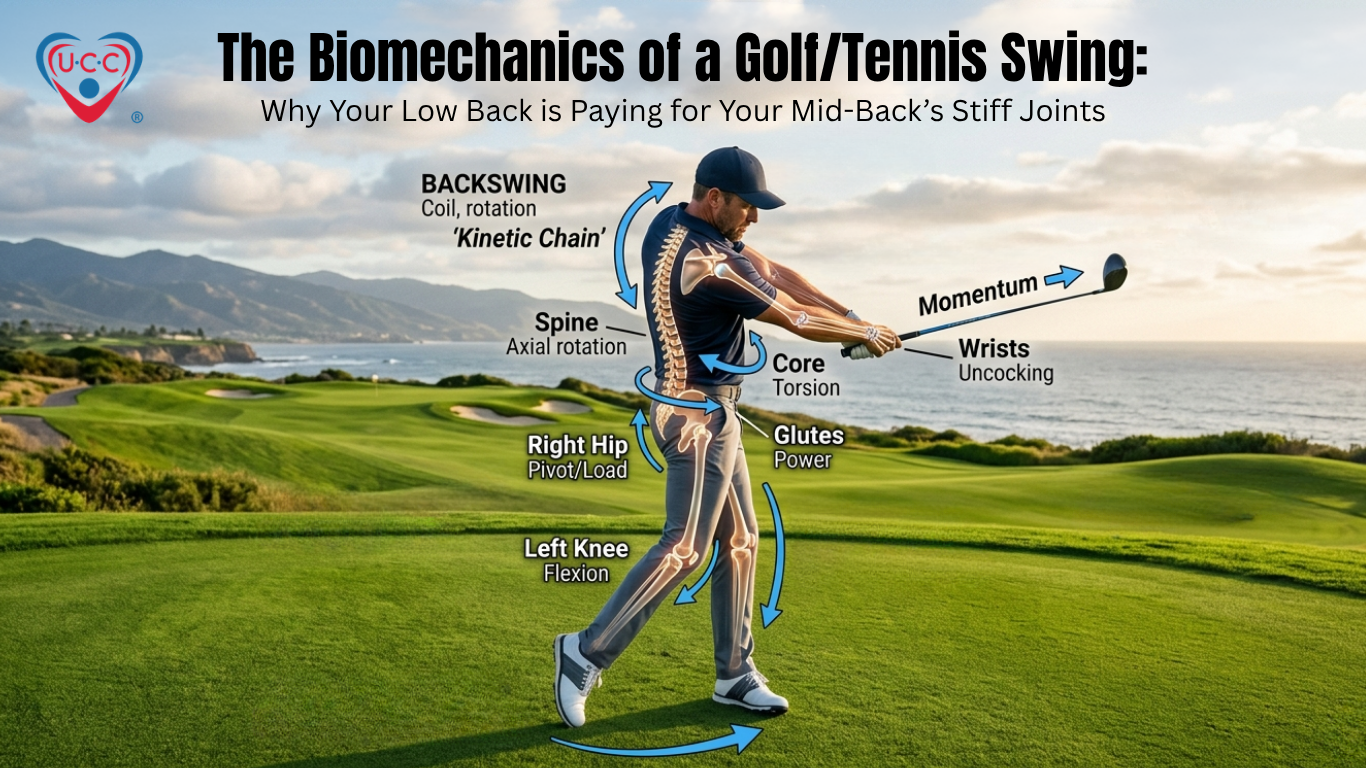
To understand why your lower back or shoulders are barking at you after a few rounds or sets, we have to look at the elegant, unforgiving physics of an athletic swing.
The Mobility-Stability Alternating Chain
Your body’s musculoskeletal system functions like a synchronized dance crew. For fluid, powerful athletic movement to happen, your joints alternate between needing to be highly mobile and needing to be highly stable.
From the ground up, the chain looks like this:
-
Foot: Stable
-
Ankle: Mobile
-
Knee: Stable
-
Hip: Mobile
-
Lumbar Spine (Lower Back): Stable
-
Thoracic Spine (Mid-Back): Mobile
-
Scapula (Shoulder Blade): Stable
-
Glenohumeral Joint (Shoulder): Mobile
Notice the crucial transition in the middle of your torso. Your thoracic spine (the 12 vertebrae that connect to your rib cage) is anatomically built for rotation. It is designed to twist. Your lumbar spine (lower back), on the other hand, is built for stability and weight-bearing. Its joints allow for plenty of bending forward and backward, but they only allow for about 5-15 degrees of total rotation.
When your body works the way it’s designed, your mid-back twists to wind up the swing, your hips drive the power, and your lower back safely anchors the middle.
What Happens When the Mid-Back Locks Up?
After months of winter bracing, prolonged desk sitting, and hunched posture over screens, your thoracic spine loses its ability to rotate. The joints lock up, and the surrounding musculature stiffens.
But when you step up to the tee box or baseline, your brain doesn’t care that your mid-back is stiff; it only cares about executing the swing. The club or racket must get all the way back.
If the thoracic spine cannot provide that rotation, the body doesn’t just stop. It forced to find that motion somewhere else. It forces the closest neighbors to compromise:
1. The Lower Back Over-Compensates (The Lumbar Twist)
Because your mid-back won’t budge, you force your lower back to twist past its anatomical limits to complete your backswing or follow-through. Forcing joints built for stability to act like joints built for mobility causes micro-tears in the lumbar ligaments, facet joint irritation, and severe muscular spasms. You aren’t hurting your lower back because you’re using it too much; you’re hurting it because your mid-back isn’t doing its job.
2. The Shoulder Decelerates the Load (The Shoulder Pinch)
In a proper swing, torque is generated by the torso. When thoracic rotation is limited, you lose that structural power. To compensate, you instinctively try to “muscle” the ball using purely your arms and shoulders. This forces the delicate rotator cuff muscles to absorb massive deceleration forces they weren’t built to handle, leading to early-season tendonitis, impingement, and labrum strain.
Treating the Root Cause, Not the Symptom
If you treat a golf or tennis injury by solely massaging your lower back or putting ice on your shoulder, you are treating the echo, not the shout. You might get temporary relief, but the moment you swing a club or racket again, the exact same strain pattern will return.
To play pain-free this summer, you have to unlock the restricted joints in the thoracic spine and restore proper mechanics to the entire kinetic chain.
How Structural Chiropractic Alignment Keeps You on the Course:
-
Restores Segmental Mobility: Targeted adjustments gently un-jam locked thoracic vertebrae, instantly freeing up your natural rotational range of motion.
-
Offloads the Extremities: By restoring movement to the mid-back, your lower back can go back to being stable, and your shoulders can stop overworking.
-
Optimizes Biomechanical Efficiency: When your structural frame moves symmetrically, your swing velocity increases, your fatigue decreases, and your risk of early-season injury drops drastically.
Don’t let a hidden mobility restriction ruin your summer season before it even gets into full swing. Let’s evaluate your thoracic rotation, clear out the winter stiffness, and get your movement back in sync.